


- Selected for Gartner Market Guide 2024 and 2025

- Insights
How to select the best eIDAS 2.0 intermediary
EUDI Wallets are arriving fast. The criteria that matter when choosing an eIDAS 2.0 intermediary for your business.
ㅣ
Paola Markart
ㅣ
5 min read
How to select the best eIDAS 2.0 intermediary
In just three months, EU citizens will begin gaining access to their European Digital Identity (EUDI) Wallet, a shift that will redefine how people prove their identity online and how organizations interact with customers. And while the regulatory enforcement deadline is set for 2027, adoption will start much sooner. Businesses need to be ready for real users presenting their EUDI Wallets within months, not years.
This creates a narrow window to become eIDAS-ready. Businesses that wait until the last minute risk being unprepared to onboard customers smoothly and prove compliance. Attempting to build direct integrations with multiple wallet providers across Europe is both technically complex and operationally challenging.
That’s why intermediaries are a strategic choice: they provide the compliance, trust and scalability layer that makes the EUDI ecosystem usable at scale.
This article outlines the right questions to ask, the criteria that matter and highlights why Hopae Connect is the most future-proof choice.
What is an eIDAS intermediary?
According to the eIDAS 2.0 Architecture and Reference Framework (ARF), intermediaries are a special class of relying party within the European Digital Identity (EUDI) ecosystem.
They are neutral trust actors that request attributes from digital wallets on behalf of businesses, verify the authenticity and status of credentials, and delete the data immediately after use.
In short: intermediaries provide the trust layer of digital identity, ensuring that every exchange between issuers, holders and relying parties is valid, secure, and compliant.
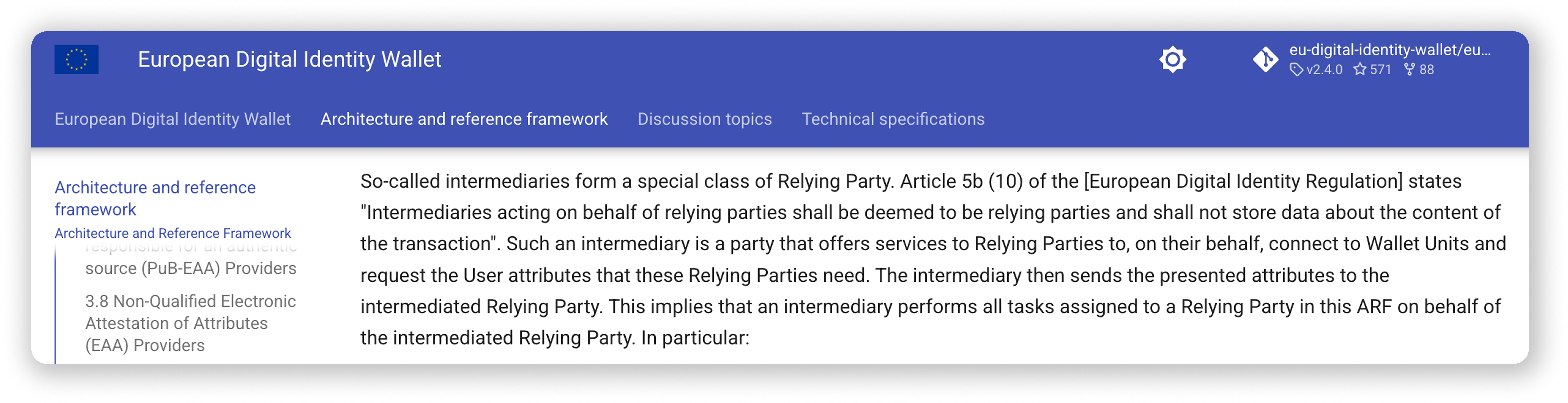
eIDAS 2.0 Architecture Reference Framework — 3.11 Relying Parties and intermediaries
How intermediaries differ from regular eID brokers
While both intermediaries and eID brokers relay information, there are two major differences:
Authenticity Checks
Intermediaries verify the authenticity of issuers, holders, and relying parties.
They validate credentials and confirm authorization at every step.
Brokers, by contrast, simply forward data without this verification layer.
Traceability & Audit-Readiness
As Qualified Trust Service Providers (QTSPs), intermediaries add timestamps and digital signatures to each transaction.
This makes every interaction traceable and auditable, providing businesses with compliance-ready proof in case of regulatory audits.
Brokers lack this traceability and cannot guarantee audit-readiness.
Choosing the right intermediary: Questions to ask
When assessing potential intermediaries capabilities; product, compliance and fraud teams should ask themselves:
Based on our business ambitions, can we select the eID and wallet schemes based on the use case / geo-location?
Do they integrate natively with eIDs, or do they rely on aggregators?
What are the use cases that we would like to cover and do they require distinct Level of Assurance (LOA)?
Is the provider a Qualified Trust Service Provider (QTSP) and is it registered as such in the trust services ecosystem?
Are they committed to interoperability across borders and industries?
Does the intermediary store personally identifiable information (PII)?
Note: Under eIDAS 2, an intermediary should not store any data.
What are the latency benchmarks?
Do they provide developer-friendly APIs, SDKs, and sandboxes?
Can fraud detection, monitoring, and analytics be integrated seamlessly?
Do we get visibility and control through a console, or are we dependent on black-box processes?
What are the possible evolutions of the proposed services (attestion issuance, wallet, …?
Is the solution App based, web based and what are the customization options?
The core deal maker is to select a pre-qualified intermediary that demonstrates robust compliance-by-design, a proven track record of interoperability with diverse national schemes, and a clear, active roadmap for EUDI Wallet integration.
The intermediary check list
Not all “intermediaries” are equal. Some offer only basic technical connectivity, while others provide the full compliance, trust, and resilience layer that enterprises in regulated industries require. The difference matters: in the EUDI Wallet era, your choice of intermediary directly impacts how quickly you can onboard customers, how confidently you can prove compliance, and how effectively you can prevent fraud.
When evaluating intermediaries, it’s tempting to focus solely on eID coverage and/or price. But the real differentiator lies in how deeply the intermediary is built into the regulatory, technical, and operational fabric of the EU’s digital identity ecosystem.
Here’s what distinguishes truly trusted intermediaries:
High LoA Alignment
Ensure the intermediary maps eIDAS 2.0 and NIST 800-63, and provides high LoA capabilities (low, substantial, and high management).
Data Normalization
A strong intermediary harmonizes attributes across Member States, tagging them with assurance levels so onboarding is seamless.
User Experience
Deep customization capabilities to enhance the end-user experience in its journey.
Performance Guarantees
Low-latency credential exchange, automated failover, and transparent SLAs are critical.
Auditability & Transparency
Comprehensive logs of credential flows, user consents, and access records ensure you can prove compliance at any moment.
Neutrality & Privacy
True intermediaries do not store user data. They enable real-time exchange, then delete — ensuring neutrality and GDPR alignment .
Native eID Integration
Direct integrations of national eIDs provide full control and independence. By avoiding third-party aggregators, you gain higher reliability and keep ownership of the user journey.
Future Readiness
Beyond eIDAS 2.0, intermediaries should anticipate AML-R, PSD3/PSR, sectoral regulations (banking, telecoms, healthcare, travel) to ensure you’re future-proof.
Why Hopae Connect is the intermediary for you
Hopae Connect was designed to be the missing identity layer of the internet. As the intermediary in identity, it enables relying parties to:
Access any EUDI wallet across Europe through one connection
Stay ahead of compliance, with built-in support for supervisory requirement
Reduce fraud through advanced verification
Accelerate onboarding with minimal latency and a developer-first API
What makes Hopae Connect stand out?
Hopae Connect is:
Upcoming official registered Intermediary service in the EU
Hopae has partnered with INCERT GIE, Luxembourg’s sovereign digital trust agency, to position Hopae Connect as a pioneer intermediary service in Europe pursuing official registration under eIDAS 2.0
Unmatched Coverage
100+ national eIDs and the EUDI Wallet supported, across all EU Member States.
Strong Assurance Enforcement
Ability to manage the LOA and data retrieved, enabling all relying parties to meet strict regulatory demands.
Data Normalization & Harmonization
Standardized attributes and assurance tagging across countries to reduce onboarding friction.
Enterprise Control Console
A powerful management console offering configuration and monitoring — giving product and compliance teams visibility and control.
Built for Resilience
Low-latency credential flows, high availability, and integration with fraud monitoring and AML systems.
Final thought
The decision to choose an intermediary isn’t just a technical to do on a checklist. It is a strategic infrastructure choice — one that will shape how your organization interacts with customers, regulators, and markets in the EUDI era.
Hopae Connect is aiming to deliver the first sovereign intermediary service in Europe. With INCERT GIE as its foundation, 100+ eIDs covered, and built-in compliance, Hopae Connect is the safest, fastest path to future proof your business.
Request a demo and see how Hopae Connect can become your trusted bridge to the EUDI Wallet ecosystem.