- News
The future of digital identity: Why 2026 changes everything for enterprises
ㅣ
Maïlys Mas
Digital identity was once a niche topic for a handful of people. Today, it’s becoming the trust layer of the internet. Governments are rolling out large-scale digital ID schemes and wallets. New standards like Decentralized Identity (DIDs) and verifiable credentials are moving from whitepapers into production systems. And for the first time, hundreds of millions of people are starting to use government-issued digital identity credentials in their daily lives.
Yet for many companies, one big question remains: how do we actually plug into this new world of government eIDs and digital identity wallets?
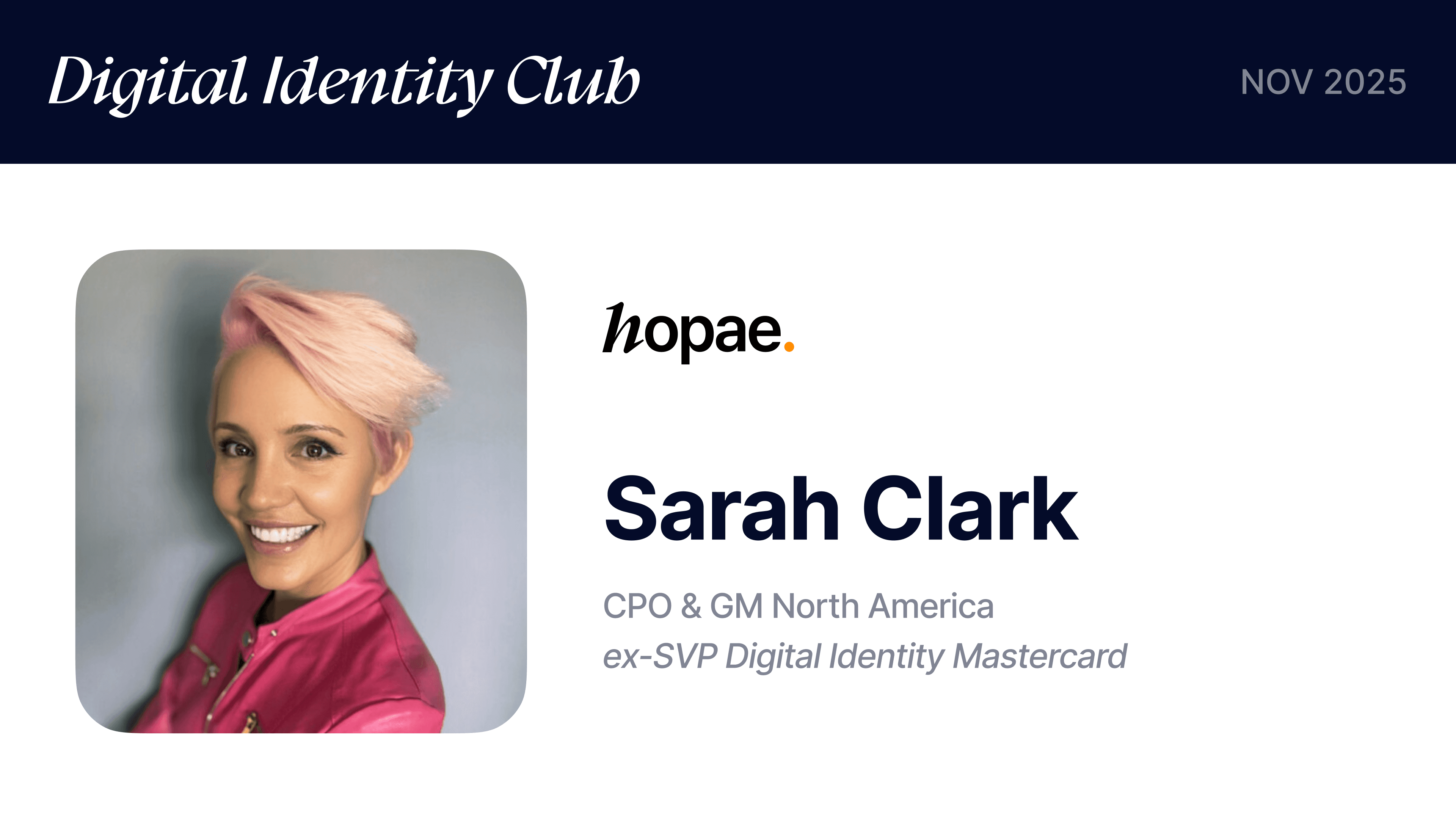
In this month’s Voice of Identity, we explored that shift with Sarah Clark, newly appointed Chief Product Officer and GM North America at Hopae.
Over the past decade, she has built one of the earliest digital identity verification businesses at Mitek, led commercial digital identity efforts on top of IDEMIA’s global government footprint, and served as SVP Digital Identity at Mastercard, where she led the initiative to build a privacy-preserving, globally interoperable digital ID network.
Let’s unwrap why 2026 will be a pivotal year for digital identity wallets, and why regulated companies, and IDV players need to start integrating global eIDs now, not later.
From bank check photos to global digital ID networks
Question (Q1.) Your background spans technology, product leadership, general management, and digital identity. How did you first get into digital identity, and what convinced you to stay?
Sarah Clark (S.C.): My journey started at Mitek as Head of Product. At that time, Mitek was working with almost every major bank in the U.S. We had a computer vision platform that allowed people to capture a check picture on their mobile device and deposit it into their bank account.
My challenge was to find the next big use case for that technology.
When we asked banks what else they needed, the answer was consistent: digital onboarding was the pain point. They wanted to move account opening online but still needed strong KYC and identity proofing.
We realized we could repurpose our technology to capture physical government-issued IDs, use that as a basis for identity proofing, and combine it with biometrics as part of the digital onboarding flow. That was the beginning of our identity verification business.
Through that work I discovered the broader field of digital identity. The more I learned, the clearer it became that the number one problem in digital identity is that:
“The internet was never built with an identity layer, and without that foundation, trust was missing, even though it is vital for every digital experience.”
This need for a digital identity trusted layer has only intensified as digital channels multiplied, fraud scaled up, and technologies like AI created new attack vectors. Digital identity simply wasn’t part of the internet’s original design, and we’re now catching up.
Once I saw that gap, I became very passionate about helping solve it. That’s why I’ve stayed in this field ever since.
When the pieces started to align: government programs, standards, and wallets
Q2. You later worked at IDEMIA and Mastercard, both deeply involved in government and network-level initiatives. What changed in those years?
S.C.: At IDEMIA, I worked on extending their strong government digital ID footprint into commercial use cases. That reinforced a belief I still hold that a clean global digital identity framework starts with government-issued credentials as the root of trust.
The real inflection point came when I joined Mastercard in 2020, right in the middle of COVID-19. Mastercard was pursuing an ambitious vision: a privacy-preserving, globally interoperable digital ID network. The idea was to connect government-issued digital IDs and reputable private credentials to a network that relying parties could use, on websites, in mobile apps, or in person, with a strong governance layer and clear operating rules.
It was like applying the logic of card networks to identity: if you see the mark, your digital ID should work there. Around that time, several forces converged:
Governments started accelerating investment in digital ID infrastructure, partly driven by the pandemic and the need for remote access to core services.
The W3C standards for Decentralized Identity (DIDs) and Verifiable Credentials were ratified, giving everyone a common technical language for decentralized, privacy-preserving identity.
Those two elements shifted digital identity from a side-topic to a core piece of global infrastructure.
The gap between digital identity and companies’ adoption: fragmentation
Q3. If governments and standards are moving, why are enterprises still slow to adopt government eIDs and wallets?
S.C.: The biggest barrier is fragmentation. Almost every country is doing something in digital identity, but they’re doing it differently:
India’s Aadhaar is a centralized, multimodal biometric system.
The EU is taking a wallet-based approach with the EUDI Wallet.
Other governments are testing various models in between.
Those differences reflect local culture and policy, but for global companies they add up to a maze:
Different protocols, APIs, and integration patterns
Different liability and trust models
Different compliance rules and user experiences
If you’re a global enterprise or an IDV provider serving global clients, you can’t afford to integrate and maintain dozens of separate schemes and keep up with all their changes.
That’s why we’re seeing a lag between government issuance and enterprise acceptance.
What’s needed is an intermediary infrastructure layer, like Hopae provides, that:
Handles the technical integrations
Provides a consistent developer experience
Adds a governance and operating framework on top
Reduces legal and operational overhead for enterprises
Without that layer, adoption will remain slower than it should be, no matter how many government wallets go live.
Solving the digital identity adoption gap: The intermediary layer
Q4. Given that context, what made you decide to join Hopae?
S.C.: By the time I joined Hopae, it was clear that government digital ID adoption was real. Hundreds of millions of people have digital credentials. The EU was moving faster than many of us predicted on the EU Digital Identity Wallet. Other governments were exploring wallet models as well. The missing piece was obvious: An infrastructure layer that makes it simple for enterprises to accept digital ID credentials from all these different schemes. And that’s exactly what Hopae is focused on.
What attracted me was Hopae’s commitment to:
Make integration technically simple, as close to “one line of code” as you can realistically get
Offer a consistent experience regardless of where the original eID or wallet comes from
Take on the legal, contracting, and operational overhead of working with many different eID providers
Given my experience working on networks and with governments, Hopae felt like the natural place to continue pushing this vision forward.
> Connect eIDs around the world. Learn more about Hopae Connect!
Why this matters for enterprises: more than a compliance checkbox
Q5. A lot of enterprises still view digital ID as a regulatory requirement. What benefits are they missing?
S.C: Regulation is important. eIDAS 2.0 in Europe will force many regulated companies and VLOPs to support the EU Digital Identity Wallet. But if you only see this as compliance, you’re missing most of the upside. The benefits are much broader:
Higher conversion and top-line growth
Every business wants to onboard new users quickly. Reusable credentials turn a multi-step IDV process (document capture, selfies, manual checks) into something close to a one-click experience. Faster onboarding directly lifts sign-up rates and revenue.Fraud reduction
Fraud is no longer a manageable write-off, it’s a multi-billion-dollar problem. Anchoring identity in government-issued digital credentials closes many of the gaps fraudsters rely on.Operational efficiency and reduced data risk
With a cryptographically secured, attested digital ID in a wallet, companies don’t need to maintain document-scanning pipelines or store as much raw PII, reducing both operational complexity and exposure to data breaches.Access to new markets
In some regions, physical ID documents have historically been weaker or harder to verify. As governments introduce strong digital identity systems, enterprises can leapfrog directly to those credentials and safely enter markets they previously hesitated to serve.
So yes, compliance will push enterprises to act. But the winners will be the ones that see digital identity as a growth, fraud, and efficiency opportunity, not just a checkbox.
How the US is responding to digital identity
Q6. We’ve mentioned Europe earlier, with eIDAS 2.0 regulation driving the digital identity shift. As Hopae’s newly appointed GM North America, what does this shift look like in the U.S. specifically?
S.C: In the U.S., the big visible change is mobile driver’s licenses (mDLs). After years of discussion, adoption has accelerated. Many states are already issuing mDLs, and the TSA now accepts them at airports. Big tech companies are also stepping in with Apple Wallet, Google Wallet, and Samsung Wallet allowing individuals to store their mDLs, not just rely on a state app.
Right now, most usage is at airports. The next step is for commercial use cases to connect: car-sharing, financial services, marketplaces, etc.
From a user perspective, nobody wants to keep taking photos of their license and sending them to different platforms. They want to use the digital credential they already have.
U.S. companies operating in Europe must adapt as quickly as local players
We’re also seeing age verification becoming a driver. The UK recently passed legislation that requires age verification for a variety of use cases, and that affects U.S. companies with a UK presence. We also have states enacting age verification laws. Those companies need to plug into age credentials delivered through digital identity wallets, not basic “tick a box” methods.
Finally, many U.S. companies still have limited awareness of eIDAS 2.0 and the requirement to let EU citizens use their digital identity wallets. That awareness needs to catch up quickly if they don’t want to be caught on the back foot.
> Are you a US company doing business in the EU?
Request a consultation to discuss your EU digital ID integration strategy with support from our experts.
2026 and beyond: the global shift enterprises must prepare for
Q8. Looking ahead to 2026, what trends do you expect to define the next phase of digital identity?
S.C.: I expect three major shifts converging:
1. More governments adopting wallet-based models, driven by privacy, control, and security
Governments worldwide are increasingly turning toward wallet-based digital identity, following the EU’s lead. Even countries that started with centralized systems are now exploring wallets because they deliver structural advantages:
Smaller attack surface: Credentials stored on the user’s device eliminate giant centralized databases that can be breached at scale.
Selective disclosure: Wallets and verifiable credentials let people share only what is needed (e.g., proving age without revealing their date of birth).
User ownership and control: As someone interested in Web3, I value models where individuals, not institutions, control their data and choose what to share, when, and with whom.
Privacy, fraud prevention, and user control all point in the same direction. That’s why wallet adoption will accelerate globally in 2026 and beyond.
2. Expansion from foundational identity to enriched credential ecosystems
A digital version of your passport or national ID is only the beginning. In the next phase, we’ll see more credentials move into verifiable credential format inside wallets:
Travel and border credentials
Professional licenses
Education and employment records
Eligibility credentials
Specialized sector data
This shift won’t all land in 2026, but the momentum is real. The wallet becomes a portable trust container for multiple identity attributes.
> Interested in issuing your own credentials? Book a demo with our experts.
3. Convergence with instant payments and stablecoins
As the world moves toward instant settlement and digital currency models, identity needs to match that speed and assurance. You cannot have real-time, high-value financial flows without equally strong, instant identity verification.
I expect identity and payments innovation to become increasingly intertwined.
One piece of advice for IDV providers and enterprises: start before the wave hits
Q9. If you could give one piece of advice to IDV providers and enterprises preparing for 2026, what would it be?
S.C.: My one and only advice would be to start integrating global eIDs and wallets now. If you don’t have a plan yet, you’re already late.
Even with an intermediary like Hopae that makes access much easier, enterprises and IDV providers still need time to:
Understand different national schemes
Design and refine user experiences
Work with their own customers to embed digital ID into existing workflows
Put in place measurement for conversion, fraud, and operational impact
This is a transformation, not a feature toggle or compliance checkbox. It requires pilots, experimentation, and iteration.
Demand is already here. Companies are asking their IDV partners: Can you integrate this scheme? Can you support the EUDI Wallet? Can you help us with age verification that meets new regulations?
Organizations that start now will be ready when mandatory requirements must be applied. The ones that wait for the wave to hit will be scrambling to catch up.
The opportunity is clear: A world where trusted government-issued and private credentials live in wallets, underpinned by strong standards and privacy, and can be used safely wherever people need them.
> Request a consultation with our experts to start preparing your digital ID integration journey.
- Newsletter
Be the first to know about cutting-edge IDV developments,
Hopae's latest white papers and reports, and industry breakthroughs.